
When Efficiency Undermines Transformation Capability

Can a company become more efficient and less capable of transformation at the same time?
That question matters because most restructuring programmes are good at measuring what disappears from an organisation. Fewer management layers. Lower overheads. Simplified processes. But what becomes possible afterwards?
Three different capabilities
Operational efficiency describes how economically an organisation delivers today's work. Organisational functionality describes how its current structures, decisions and collaboration actually perform. Transformation capability describes the ability to sense change, connect knowledge, adapt decisions, reconfigure resources and renew ways of working as conditions change. They overlap, but they are not interchangeable.
A seemingly healthy business may work extremely well until the environment changes. Equally, an organisation facing visible dysfunction may possess the learning mechanisms needed to rebuild itself. The absence of present-day problems does not prove future readiness.
The E.ON Polaris thought experiment
Recent manager magazin reporting on E.ON's proposed Polaris programme describes potential cost reductions of 20 to 25%, including consolidation of management functions. Grid expansion, digitalisation and operational performance add demanding conditions. Removing complexity may well be the right move. But it cannot by itself tell us whether decisions will improve, relevant expertise will be connected or resources will become easier to redeploy.
This is a thought experiment prompted by journalism, not a diagnosis of E.ON. The actual effect of its restructuring cannot be established from a single article.
From dysfunction to early indicators
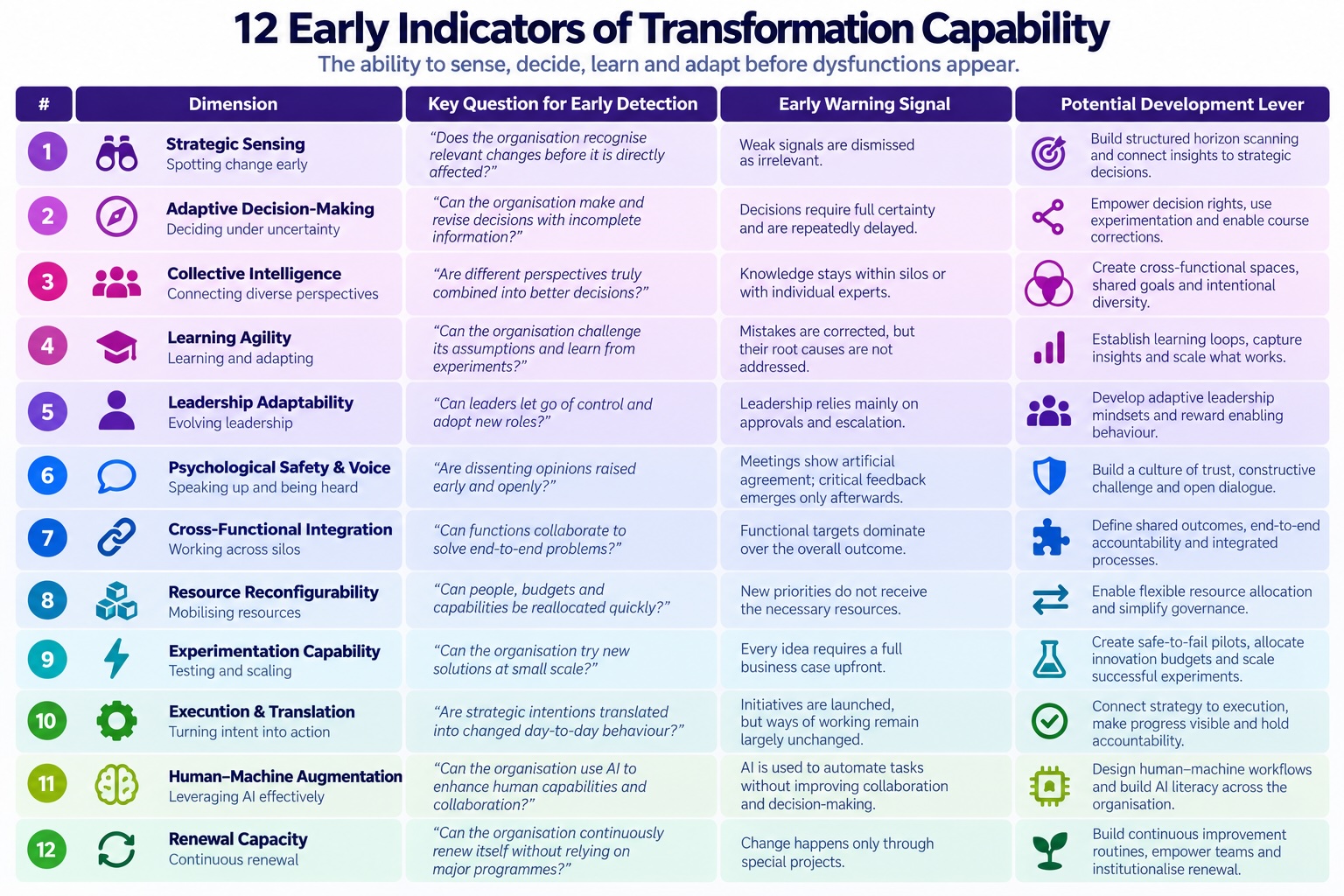
In my book research on Collective Intelligence I am exploring how we could detect the ability to transform before visible dysfunction emerges. Dynamic capabilities, organisational learning and collective-intelligence research offer valuable foundations. They do not, however, validate the following twelve-dimensional framework.
Twelve candidate early indicators
How these indicators might be measured
Self-reported agreement is not enough. Consider four forms of evidence: what people believe, what they actually do, what organisational structures enable and what outcomes subsequently change. For Strategic Sensing, examine weak signals that reached a decision forum and led to action. For Resource Reconfigurability, measure the delay between a strategic priority shift and an actual movement of budget, capacity and authority. For Collective Intelligence, examine whether information from different disciplines changes the quality of decisions, not merely whether everyone attends a meeting.
The indicators must be empirically examined for overlap, reliability, predictive validity and contextual dependence. A regulated infrastructure company may appropriately make some decisions more slowly than a start-up. Speed alone is not quality.
What restructuring should really improve
Do fewer decision-makers result in better decisions? Do consolidated teams actually integrate expertise? Does AI improve shared judgement rather than merely automating today's workflows? Does learning alter assumptions rather than produce another presentation?
Successful restructuring should be measured not only by what disappears from an organisation, but by what the organisation becomes capable of doing.
Will we simply become cheaper, or more capable of change?
keep curious. keep discovering. be fiercely human.
Sources and further research
- manager magazin, E.ON Polaris
- Teece (2007), Dynamic Capabilities
- March (1991), Exploration and Exploitation
- Woolley et al. (2010), Collective Intelligence
- Cohen & Levinthal (1990), Absorptive Capacity.
- Edmondson (1999), Psychological Safety and Learning Behavior.