
The ideal workplace
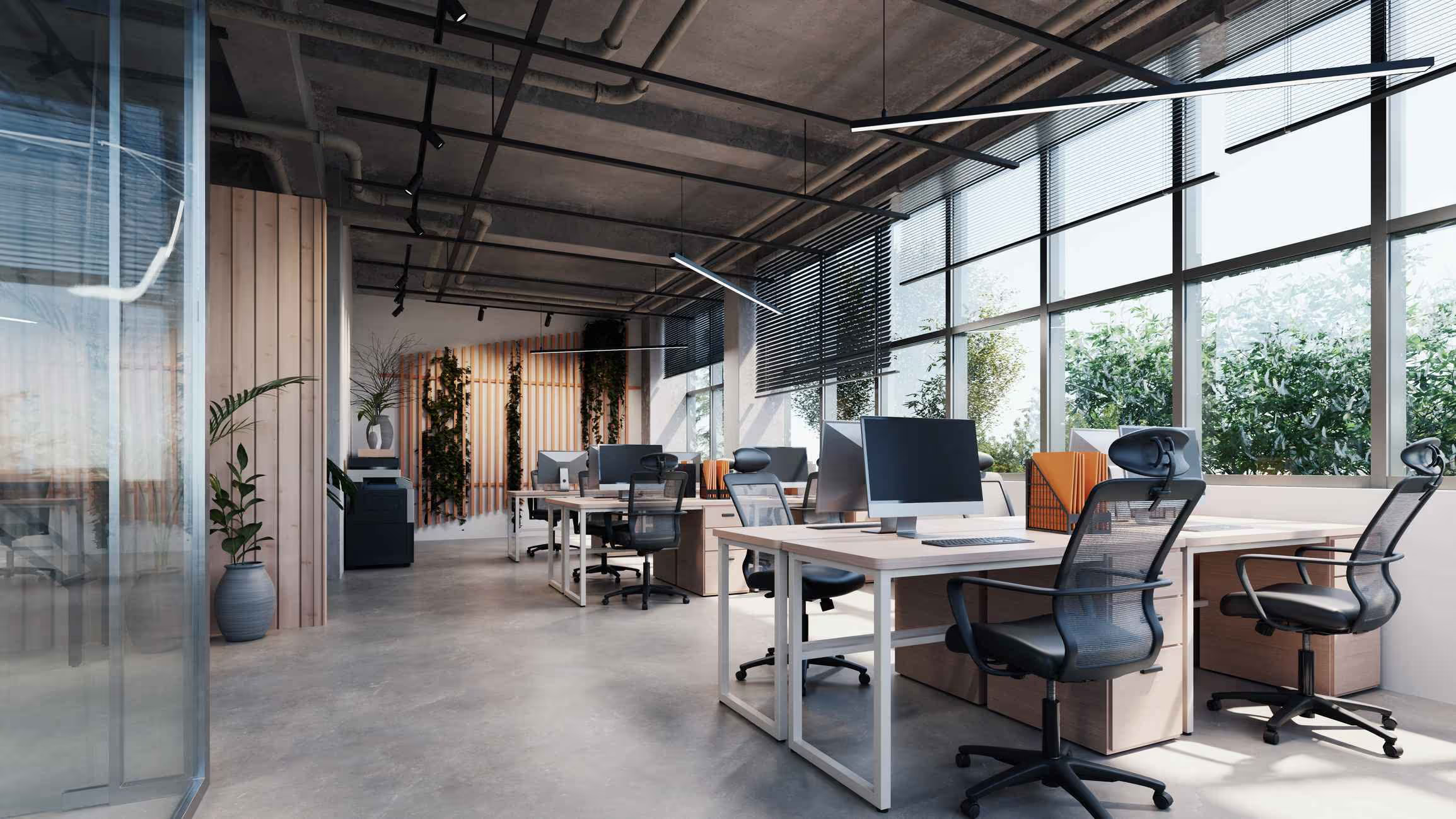
If you're one of the 48% of workers who currently work remotely (an increase of 30% in the last 3 years), you probably have the privilege of being able to design your workplace largely or even completely yourself. But for millions of workers, this was never an option and their wellbeing and motivation often suffer as a result. The energy they would normally put into their work is used to deal with a tough environment. As we have observed with one of our customers, this can ultimately lead to significant challenges for companies when it comes to retaining valuable employees and attracting new employees who provide important but often demanding services.
So how can companies design their work environment to meet the needs of their current teams and welcome potential employees to achieve the perfect mix of productivity and motivation?
Isn't it ironic that the workers who are most needed — bus and train drivers, nurses and paramedics, factory workers, and many others — often have to work under the most unpleasant and uninspiring conditions? You'd think that there isn't much room for design in such work environments without sacrificing efficiency and safety. Many of us are unaware that employees who work long shifts in comfortable and pleasant spaces perform better. Through increased physical comfort and increased mental and emotional well-being, employees can concentrate better and work more productively. But what many of us don't know is that employees who spend their often long shifts in rooms promote physical comfort and mental and emotional wellbeing, are able to concentrate better and work more productively. This in turn leads to an improved overall quality of the services provided.
Workers whose jobs affect their mental health find it difficult to focus, communicate, use their time effectively, and achieve desired results. It's no surprise. In fact, poor mental health, which leads to presentism and absenteeism, is the third highest cost burden for companies in the USA after heart disease and high blood pressure. But that's only part of the problem: Work-related stress is often not recorded. In fact, 90% of workers who take vacation due to stress give another reason for their absence.
Isn't that reason enough to take a holistic and people-centred approach to creating and modernizing workplaces? Our customer — an employer with tens of thousands of employees — said yes! So we set to work and developed concepts for his future areas of work. Here are some of the insights we've gained in the process.
1. Personalization is key for a diverse workforce
A problem that affects not only our customers but countless companies across Europe and Central Asia is the fact that 22% of the German population is over 65 years of age. Millions of workers will soon reach retirement age, and together with younger, aspiring workers, they have increasingly diverse needs that many companies are unprepared for. An appropriate strategy should not only promote diversity and inclusion in theory, but also ensure that the workplace actually reflects these values by going beyond standard design and taking a more individualized approach.
By making the effort to identify the individual needs of their employees — from the temperature and sitting position in the workplace to the type of sanitation and even the level of privacy in rest areas — they can ensure that every employee has the best possible conditions to work efficiently and comfortably. What is optimal for an employee can be fundamentally different from the needs of a colleague. By implementing individual changes, employers can ensure that their employees, regardless of their origin, physique, or abilities, feel comfortable and are able to perform excellently.
Porsche is a good example. There, managers plan working hours so that the burden on employees is minimal. For this, they use traffic light indicators: green means a good load, yellow corresponds to the load that is tolerable at home, and red indicates an excessive load. This prevents, rather than just reacting, to avoid overloads and injuries.
Employers can do many things to improve the workplace for their employees. This ranges from ergonomic chairs with built-in tools to body support during repetitive tasks. Sometimes even entire floors are redesigned in assembly factories. The list of improvements employers can make is very long. And the best part is that these improvements have many benefits for employee health and wellbeing. From integrating work tools into ergonomic chairs to easily supporting workers' bodies during repetitive tasks or even redesigning entire floors in assembly plants, the list of improvements employers can invest in is endless — as are the benefits to workers' health and wellbeing.
2. Sustainable design in the office: How 'green' workplaces increase productivity
Too often, the terms “green”, “ecological” and “sustainable design” as well as “inclusion” and “diversity” are used simply as marketing concepts, rather than as an invitation to action, which they should actually be. However, we are striving to overcome this and remember the simple truth, which has been confirmed in numerous publications: workplaces that focus on the natural environment tend to have happier and more productive teams.
A vivid example of this is provided by William Pape, co-founder of VeriFone, who reported that 18 months after redesigning their building to reduce indoor pollutants and improve environmental quality, employee absenteeism fell by 40% and productivity increased by 5%. Even though much evidence suggests that green buildings increase employee satisfaction and productivity, it is often difficult to measure the exact impact. This is due to the fact that connections between working in poorly ventilated interiors and, for example, higher absenteeism and respiratory diseases are often not established when recording sick days and costs.
So what makes a workplace 'green'? Essentially, it is about the design, construction and operation of the workplace reducing or eliminating factors that have a negative impact on the natural climate and environment. At the same time, the quality of life of employees should also be improved.
This can be achieved by:
- efficient use of resources and energy as well as recycling
- Reducing pollution and waste
- Optimizing indoor air quality
- Using sustainable and non-toxic materials.
An even better approach would be to design a work area that can flexibly adapt to changing conditions. This could include, for example, seasonal weather changes, sudden changes in weather, or increased or reduced workload.
3. Biophilic Design and Green Workplaces: Why it's more than just a trend
During our research, a question arose: What is the difference between “green” and “biophilic” design? While green building concepts focus on minimizing the negative effects of buildings on the natural environment, biophilic design elements go deeper into the relationship between people and nature and maximize the positive effects of this connection even indoors.
Research in recent decades has discovered much about the effects of contact with biophilic elements — such as natural light, plants, views of nature and water features — on our well-being, and workspaces are no exception. Considering that only around half of those who work indoors spend more than an hour outdoors a day, it's hardly surprising that interior design that strengthens our connection to nature has a positive impact on workers' mental and physical health.
Here's a look at what can happen when biophilic design is integrated into workspaces:
- Offices: Productivity can be increased by 8%; wellbeing increases by 13%.
- Educational institutions: Higher learning rates, better test scores, higher concentration and better mood, lower effects of ADHD
- Health care: 8.5% lower recovery rates after surgery; 22% less pain relievers
- Retail: Customers are willing to pay 8-12% more for goods and services when they are surrounded by vegetation and landscaping.
The best news about biophilic design is that employers are seeing impressive results even with simple changes, particularly in areas with limited space or in spaces that require a sterile or dry environment. Setting up artificial plants when space allows, playing birdsong or calming water sounds in the background, and choosing an interior design that imitates wood or, at best, uses real wood, are comparatively simple steps that still work. With this knowledge, it was all the easier for us to encourage our customers to incorporate urgently needed natural factors into the daily lives of their employees.
4. Light in the workplace: The importance of circadian light for employee wellbeing
Light is one of the key biophilic elements that have a significant impact on the well-being and ability of employees to work. It influences our circadian rhythm — our internal biological clock, which regulates our sleep-wake rhythm and hormone levels. According to this, it has both short and long-term effects on our ability to deal with stress and to work. Since we know that disturbed sleep — an increased risk for shift workers anyway — affects concentration, attention and alertness, the question is how we can develop a lighting system that enables individuals to work sustainably.
To take advantage of the many intangible assets of natural sunlight, the most effective approach is to maximize access to daylight wherever possible. If this is not possible, biophilic design principles can be applied, such as:
Intensity tuning: Create a controlled dimming system where the lighting is set to a lower intensity early in the morning, increases in intensity over the course of the day and decreases again in the evening to match the natural course of the sun.
Color coordination: cooler light colors promote attention and alertness, while color-coordinated lights would produce warmer tones, for example at sunrise or sunset. This circadian approach mimics the daylight that employees would experience outside.
In short: Create a design that imitates the natural rhythm of sunlight as closely as possible and thus promotes a healthy sleep-wake rhythm among employees.
Our findings so far have focused primarily on the design of the physical workplace. However, our research, including intensive interviews with our client's employees, has shown that what may have the biggest impact in creating and promoting the workplace of the future doesn't have to do with material elements, but with people themselves...
5. Community in the workplace: Why cohesion is crucial
Our conversations with workers have shown that no matter how beautiful the environment or how unusual the devices are, the feeling of being valued, respected, and included by colleagues and supervisors is of great importance. There is still some work to be done in this area, but employers are already doing a lot:
- Companies such as Microsoft and Google are investing in providing services to improve the work-life balance of their employees. These include childcare, physical therapy, fitness and massage centers, financial advice and advisory services.
- Hitachi Rail has developed a rewards system that is open to all employees worldwide and is based on corporate values such as honesty and innovation. Annual award ceremonies serve as an opportunity to recognize and celebrate outstanding achievements, and to share projects beyond the company's borders.
- Google also provides employees with special spaces and materials to be creative, test ideas for improving work, and explore personal hobbies.
- On the International Space Station (ISS), astronauts meet daily for “family dinners,” where a simple meal together is key to creating a sense of camaraderie, community, and fun in an otherwise limited environment.
The future of work: How companies can promote the transition to a healthy and motivating work environment
By showing our client what countless measures could be implemented at their workplaces in dozens of locations, we opened the door to a new understanding of why and how prioritizing happy and healthy employees who feel supported and empowered can lead to increased success.
Now that you know a few options, it's time to try it out for yourself! Take a look around your work environment and think about your day-to-day work. When you're leading a team, have a conversation with your employees. Are they satisfied with their working conditions? Which elements help them to work sustainably and which aspects prevent them from doing so? If you take the time to answer these questions and invest in solutions, you can help keep your employees engaged, resilient, and ready for the future.
Key Takeaways
· The physical design of a workplace can have a significant impact on employee productivity, health, and motivation and is therefore key to increasing job satisfaction.
· While companies emphasize the importance of diversity and inclusion in the workforce, workplace equipment and ergonomic design must support this diversity and meet the diverse needs of employees.
· “green” design is intended to make greater use of natural resources to improve the physical and mental health of employees. Adjustments to indoor air quality and access to daylight are effective measures.
· Biophilic design elements in the workplace should not only increase satisfaction, but also productivity, concentration and learning abilities.
· Lighting systems are an effective way to improve and maintain employee health and performance when taking a biophilic or circadian approach.
· Building a strong sense of community among employees is an indispensable factor for long-term quality of life, regardless of the type of work or industry.