
The future of smart...
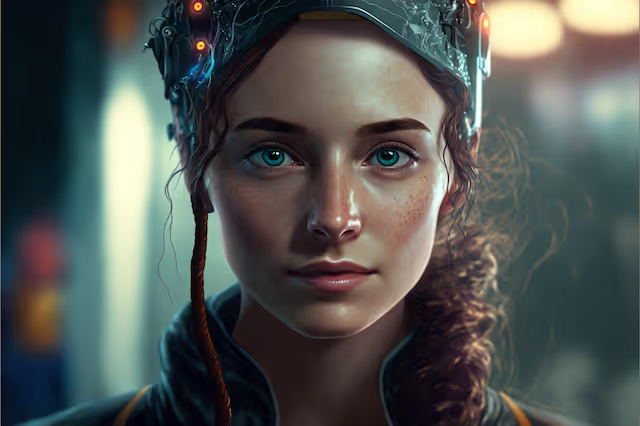
In an age in which Google's vision of unlimited access to humanity's knowledge — anytime and anywhere — is becoming more and more a reality, even through new players such as Chat-GPT, it is no longer important to carry the necessary detailed knowledge to solve tasks with you in your head. You Google this and possible connections to other details or have the required information prepared bite-sized in a chat with artificial intelligence.
So why should we compete with this artificial intelligence (AI) and try to “upload” pure information into ourselves?
On the other hand, what is becoming increasingly important is the ability to recognize connections, build creative connections between knowledge and critically question content — even morally. Being able to ask good questions helps us both in our private and professional lives. It enables us not only to search for new knowledge and insights, but also to constantly check the quality of the content. In other words, to be really smart.
Good questions
If you are able to ask good questions, you can learn more effectively. When we ask questions, we can clarify misunderstandings or ambiguities about an issue. This can help us better understand and remember the information. In addition, by asking questions, we can explore new ideas and dive deeper into a topic instead of just skimming the surface.
Asking good questions also helps us to deal with knowledge more confidently and independently. We take our learning into our own hands and seek the knowledge and understanding we want. This will make us more confident in our abilities and learn more independently.
In contrast, simply memorizing content can make us rely more on the information that is presented to us and prevent us from searching for knowledge ourselves. Sticking to memorizing content may also result in us entering into a knowledge competition with AIs in the future. We can only lose that.
Therefore, our focus should be on learning how to ask really good questions right from school, rather than simply learning facts and content. This will help us to make the best possible use of our abilities, to be more creative and to verify that information is reliable:
Knowledge
Good general knowledge and expert knowledge both have their own advantages and limits and can be important in different ways. Good general knowledge can be helpful in many areas of life, such as personal development, communication, and problem solving, while expertise is crucial for success in many professions. In today's world, you need a combination of both, a broad perspective and expertise to navigate the complex world and be successful in various areas.
For example, AI can help close gaps in general knowledge. Like developing an understanding of political and social relationships and their effects on one's own company and work. For example, we see that companies with highly specialized founders (e.g. graduates of STEM subjects) have deficiencies in these areas, which can have an impact on compliance issues. However, to fill these gaps, it is important to be able to ask the right questions so that the data used to create the answers leads to the correct and up-to-date solutions.

A common prediction made by various experts is that around 2/3 of the jobs of the future will require completely new roles and skills, as they have a high degree of interaction with AIs, among other things. It must also be our task to prepare older generations for this.
AI has the potential to significantly influence and partly replace the role of expert knowledge in various areas. In some cases, AI-based systems can be trained to perform tasks that normally require expert knowledge, such as medical diagnoses, financial forecasting, and legal research. AI-based systems can also support experts in their field by providing them with information that would be difficult to obtain or process manually. They also help us automate some of the tedious and time-consuming tasks.
The question therefore remains as to what extent good general knowledge and expertise in a specific area, profession or industry will still need to be mastered in the future. Or whether the use of AI will soon free ourselves from laboriously learning knowledge before we can understand and question complex information and concepts in a subject area. Automating certain aspects of working with expert knowledge will certainly reduce the need for pure human expertise in many areas more and more.
However, AI will not be able to completely replace experts one day, but will rather help them expand their knowledge in order to use their human capabilities correctly. And we humans will particularly need our ability to question them. We must be able to reflect on their findings in order to understand the results and make informed decisions based on them. In addition, AI-based systems must also be trained and maintained by experts in the field. This offers experts the opportunity to remain relevant by working on the development, maintenance and monitoring of the AI system and continuously improving it — including being able to question AI functionalities.
We will see that artificial intelligence will lead to more expertise in humans. However, this knowledge will not be developed through pure memorization, but through asking good questions and the associated experience of being able to master AIs better.
Creativity
In today's fast-paced and rapidly changing world, a combination of good general knowledge and expertise is often considered essential to spark creativity. Good general knowledge helps to broaden our perspective and provide the context and understanding we need to specialize. It helps us develop transferable skills, such as critical thinking and problem solving, which are important in every area. Ok.
What is needed in the future is rather easy access to comprehensive basic knowledge across various topics and disciplines. It creates opportunities to establish connections between different areas of knowledge, to think critically and creatively, and to communicate effectively with others. In short, good general knowledge from many areas of life, or even access to it, helps us with personal development, communication and problem solving. It also helps us to better understand and navigate the world around us, such as current events, social and political issues, and cultural trends. What it requires is to have unlimited access to it. We just need to understand how to handle the variety and amount of information better — and this is where being able to ask good questions helps us.
One of the main benefits of being able to ask good questions is that it encourages us to think critically and question our assumptions. When we ask questions, we actively engage with the information and try to understand it. This process enables us to think more deeply about a topic and to consider and combine different perspectives.
In contrast, simply memorizing content doesn't necessarily require us to think critically or question our convictions. It may be that we simply ruminate the information without fully summarizing it or considering alternative points of view. Or even worse, that we're spending an unnecessary amount of time collecting information, such as memorizing it, while it's just a few clicks away. Instead, this time should be used to strengthen our understanding and creativity with strong questions.
Dependability
Online content is an important engine for innovation and human development. They have facilitated the dissemination of new ideas and the development of new technologies, improved access to information and resources, and increased citizen participation and accountability. It has also strengthened individuals and communities and changed the way we work and communicate. The continuous development of the Internet and online content has the potential to further drive innovation and progress in the future. And as artificial intelligence makes content more and more accessible, you could imagine a world in which learning as we know it today becomes superfluous.

One quality that we must learn is to be able to independently evaluate the reliability of information.
But the reliability of content on the Internet can vary greatly. While there is a wealth of accurate and reliable information that can help answer almost any question, there is also a significant amount of inaccurate or misleading information. One of the main reasons for the varying reliability of online content is that anyone can publish information without necessarily having qualifications or expertise in the area. As a result, a wide range of information is available online, from credible sources such as scientific journals and government websites to less credible sources such as personal blogs and social media posts.
Another factor that can affect the reliability of online content is the potential for misinformation and disinformation to spread rapidly and be widely believed through social media and other online platforms, even if refuted later on. In addition, the anonymity and accessibility of the Internet enable a wide range of actors to spread unreliable and malicious information. From propaganda and political manipulation to phishing and fraud.
To determine the reliability of online content, which usually also forms the basis for AIs, it is important to assess the credibility of the source and look for evidence to support the claims (e.g. indicators such as the author's qualifications and expertise, publisher reputation, publication date, and whether the information has been reviewed by professionals, images used,... or external links, fact-checking, and the impartiality of sources).
Ultimately, it is up to each and every individual to be able to judge the reliability of this information that is found on the Internet. If you have the ability to be critical and skeptical and review information from various sources, you can distinguish the reliable information from unreliable or misleading content and thus also determine the quality of an AI. And based on the answers, we can then also decide whether we need regulatory intervention or not.
Looking to the future
AI will significantly impact the role of expert knowledge, but it won't replace it. AI-based systems can complement expert knowledge by providing new insights and automating certain aspects of working with them, but they still need human expertise to understand the results and make decisions based on them. Instead of replacing the role of experts, AI can support them and make their work more efficient, leaving more time for higher-level tasks that require specialized human skills and knowledge... right down to our intuition.
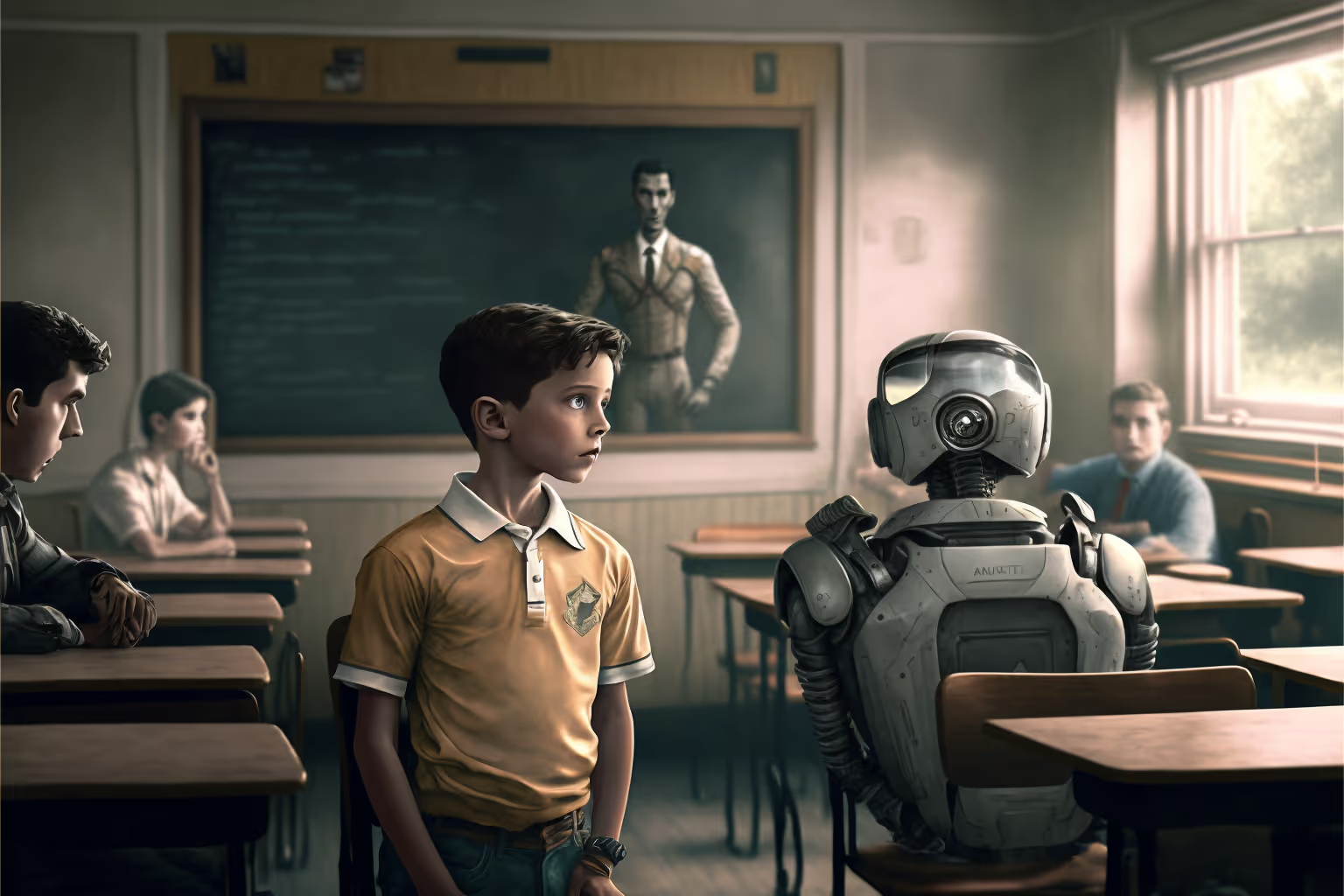
In the future, it will be particularly important to strengthen our imagination and ask good questions.
Asking good questions will lead us to discover new knowledge and understanding with the help of AIs. This will lead to the development of new theories, findings and a better understanding of our world — or simply put: to more creativity. In contrast, memorizing knowledge will be replaced more and more or made much easier.
Asking good questions will help us communicate better with each other in the future. We will incorporate our own understanding of a topic into meaningful discussions with others and AIs. We'll work better with others and learn from their perspectives.
In summary, it will be more important for us humans to ask good questions than simply to learn content by heart, because it promotes our strength to think critically as well as intuitively. This is the biggest differentiation potential and our biggest advantage over AIs. Questions will help us learn more effectively, discover new knowledge and sharpen our understanding. They can help us improve our cooperation, strengthen our democracy and give us the opportunity to deal with content more confidently and self-directed. Even though memorization is justified in certain situations, it is the ability to ask good questions and think critically about information that will determine our role as people in the long term.
Excursus
Just recently, ChatGPT, a language model software developed with the help of OpenAI, revolutionized the search for information. ChatGPT* can talk to us and understand what we (want) to say.
The program uses “deep learning” to understand and use texts like a human being. It's as if you've been assigned a very smart robot friend who answers all our questions, talks to us and has access to the entire body of humanity's knowledge at any time. And in a future that is probably not too distant, we will be able to simply upload this required knowledge directly to our brain via a data line (see Neuralink and Co.). Anytime, anywhere.
By the way, this content was inspired by a dialogue with Chat-gPT3 lasting several hours in January 2023.
*Note: As I write this, the GPT-3 version is able to process 175 billion parameters. Within the next few weeks, GPT-4, with the almost incredible ability to process unimaginable 100 trillion parameters, is to be introduced. I am certain that this will result in completely new insights for humanity.
PS: I wrote this article as a contribution to the new edition of the book “How To Foster Creativity In The 21stCentury” by dear Leonard Sommer. Leonard has created great value with this book, which provides inspiration and knowledge about how to awaken our great human capacity. Thanks Leonard for being able to make a small contribution to this. The new German edition can be ordered here: https://www.startnext.com/wenn-schule-auf-ideen-bringt