
The currency of the modern age: The true value of data

The exchange of data between companies and their customers has become a key element in the modern business world, shaping and defining the relationship between both sides in a new way. In this context, we are today diving into the data landscape of the European travel industry to answer one of the key questions that our customers often ask themselves: What is the value of our available or accessible data, and how can it be used to increase sales and improve our business strategies?
Be honest: How much money would you be willing to pay to gain full control of your private data — from your search history, food orders, health records, and jogging route to every single transaction you've ever made? Or maybe we'd better ask ourselves: How much money could you make by selling that data to companies that need it? And what if you traded them on the dark web? Can you actually measure how much valuable information you generate with every move you make on the Internet?
Data in focus: How companies can maximize the value of their information
As a think tank company that works closely with other companies and corporations to realize their vision of the future for the next 5 to 10 years, we constantly address our clients' questions about data and its limitless application. Where do you get this data, how to manage it efficiently, what you use it for, and who you share it with — these questions are constantly evolving. But one thing is beyond question: Data is critical to the success of any product or service in today's and tomorrow's markets. With the continuous development and increasing accessibility of mobile technologies worldwide, customer expectations of the companies they interact with are increasing. Data-based decision-making is the key to meeting and exceeding these expectations.
The good news is that huge amounts of data are already available and the younger generation in particular is willing to share their personal information in exchange for a more efficient and personalized customer experience. A British study found that 75% of consumers aged 16 to 24 agree to share their data with brands, compared to just 45% of those aged 55 and over. One challenge that companies often face, however, is the lack of the appropriate infrastructure, organizational culture, and analytics required to turn this data into meaningful insights. Even more serious is the lack of a clear objective for using this data, which is derived from corporate mission statements and is in line with corporate values. According to a 2021 survey by NewVantage, 99% of companies are investing in big data, but only 30% said they have a clearly defined data strategy, and even fewer (24.4%) have established a company-wide data culture.
What is the use of data — regardless of how much it is — if it does not serve a clear purpose? And how can the value and purpose of this data be determined?
WHERE DOES THE DATA COME FROM?
Data collection often starts with the customer's first interaction with a company online. Whether it's booking air or train tickets on a website, reserving a parking space via an app, or browsing retail offers on social media, customers use digital tools to provide companies with data. This data enables companies to optimize the user experience and ultimately save time and effort for both new and returning customers.
Data usage in the travel industry: From potential to monetization
While working with companies in the travel and mobility industry, we have identified a variety of points of contact for data collection. For example, when a traveler enters an airport:
- Security cameras and Bluetooth sensors record his movements and length of stay
- Transactions at duty-free stores, retailers and F&B (food & beverage) stores record shopping and catering preferences
- By combining parking reservations with flight booking data, conclusions can be drawn about travel frequency and behavior
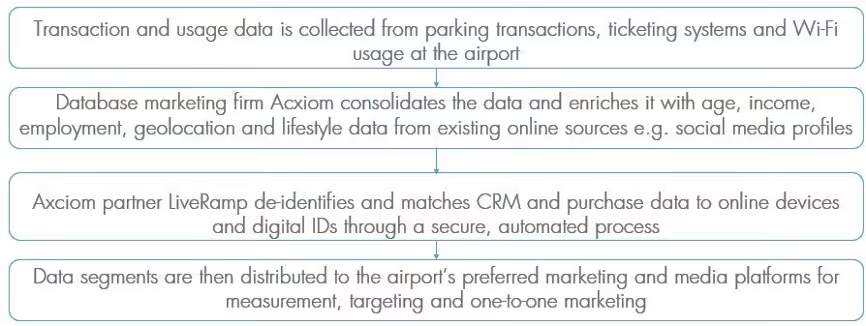
As soon as customers agree to share their personal information with a company — whether by logging into a Wi-Fi network, downloading an app, or logging into a website using their social media accounts — a profile can be created that represents their actions and preferences. In this way, companies can develop dynamic customer relationship management (CRM) strategies and base business decisions on a realistic, detailed picture of customer behavior and needs. In Figure 1, you can see how this is being implemented at Heathrow Airport in partnership with database marketing company Acxiom.
How can data reach its full potential?
We're all aware that the value of data is constantly changing as new, more sophisticated tools for data collection and analysis emerge. But it is already clear that the potential of a company's data cannot be fully exploited through infrastructure and analytics alone. There is a need for a corporate culture that promotes the sharing of data and focuses on cooperation with relevant local partners. Especially in the complex structure of companies in the mobility sector, such as airports, collaboration is essential to link data silos and create a comprehensive picture that has more value than the sum of its parts. We recognize the importance of data security and data protection, but we also believe that without effective collaboration between colleagues and teams and clear processes for data exchange, valuable knowledge is wasted and opportunities could remain unused.
In summary, a clear data strategy that is in line with the company's philosophy, combined with a stable data infrastructure, powerful analytics and the right corporate culture, makes it possible to optimize business and operational processes. This in turn results in higher revenue for the company and a satisfying, seamless experience for customers.
Data monetization at airports: insights into European best practices
Our research shows that data-driven decision-making is already benefiting businesses and customers across Europe and beyond, particularly in the areas of travel and mobility. In doing so, we focused our attention on leading companies in this sector and took a closer look at best practices. But what exactly has been done so far?
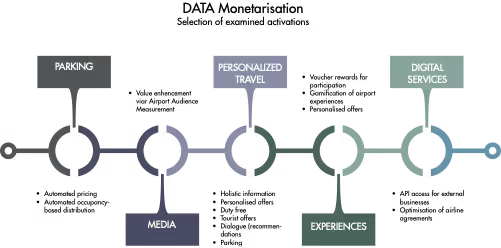
Figure 2 provides an overview of how European airports are tackling data monetization. Most initiatives focus on personalizing the customer experience in order to further increase revenue via existing channels such as parking, duty-free, retail and F&B. The strategy is quite simple: collect data about customer behavior while traveling, combine it with sales data from retailers, F&B locations and parking services, and thus inform and further develop CRM.
To name just a few airports that are setting a good example:
· In Frankfurt, media spaces are designed based on length of stay in order to create first-class advertising spaces;
· Vienna integrates passenger flow data into the design of duty-free areas;
· Zurich provides dynamic, automated pricing for parking reservations and collects usage data for predictive analytics to maximize parking capacity;
· Dublin, Barcelona and Milan foster personal relationships with every passenger by distributing targeted offers and rewards via apps and social media at various points in the CustomerJourney;
And there are many more successful examples...
The art of data evaluation: Why not all data is the same
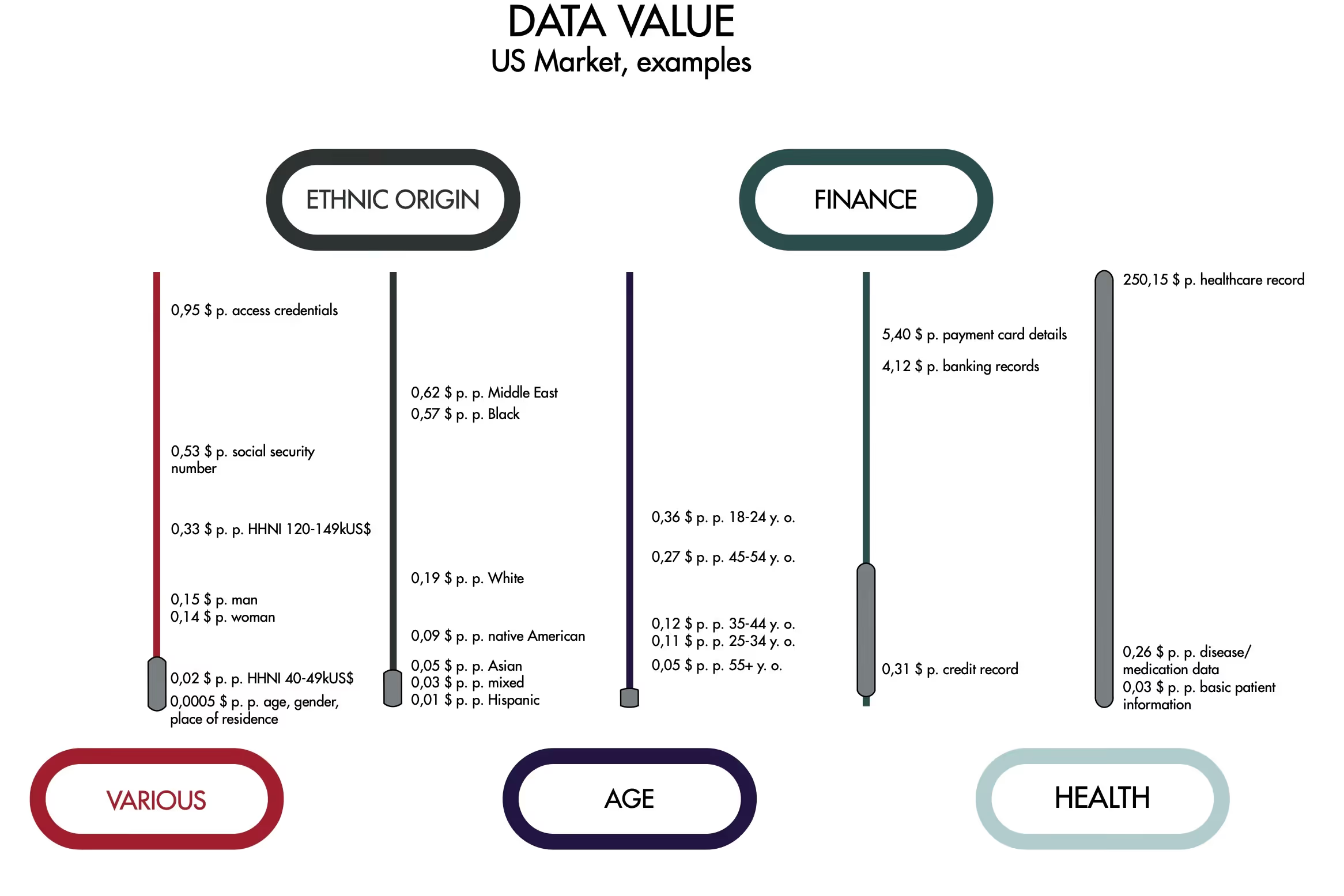
Evaluating the monetary value of data is extremely complex. Figure 3 shows that pricing in the USA does not treat all data equally. The type of data and the associated target group have a significant impact on its value. This effect is cumulative, meaning that data becomes more valuable as more information is available about the same person. This even includes details of important life events such as marriage or buying a house, which often go hand in hand with specific needs and enable targeted advertising measures.
Data is money: How companies can increase the value of their customer information
Companies usually collect data from users in a legitimate way. However, the prices of data acquired under less stringent conditions illustrate the true value of data in today's world. An evaluation in the USA (see Figure 4) shows that the type of data collected is the decisive factor in pricing. Health data is significantly more valuable than other types of data because it often contains more comprehensive information about the patient's identity and medical history. As far as ethnicity, age, and income are concerned, the value of a particular demographic group's user data appears to be inversely proportional to the frequency of the group: the smaller the population, the higher the price.
One interesting finding comes from the pricing of user data: Data from low-income earners (with an income of less than 10,000 dollars per year) is more valuable at a price of 0.10 dollars per user than data from users who earn up to 120,000 dollars, who only have a price of 0.04 dollars. This is because low-income earners are often students who, despite their limited income, like to discuss products online and unintentionally reveal valuable information in the process. Data from users who earn more than $120,000 — who have less financial stress and are therefore able to shop more freely and actually have the means to make purchases — is by far the most valuable at $0.33 per user.
This ranking is based on a pricing system that is based on value. The costs for a data set are determined based on the potential revenue that it can generate. However, there is also another approach to evaluating data, namely cost-based pricing. Here, a data set is sold at a price that covers procurement costs. But what if users could decide for themselves the price of their own data?
What value would users attribute to their data themselves?
The Technology Policy Institute in the USA investigated this question in 2020 and found that:
- German users would charge Facebook about 8 dollars a month to share their contact details, while US users would only charge 3.50 dollars;
- Users would charge $8.44 a month to share their bank details, $7.56 to share their fingerprint, $6.05 to read their text messages, and $5.80 to release cash withdrawal information;
- It was only $1.82 per month to share location data, and users were happy that they could receive free advertising via SMS.
Looking to the future: How companies today understand tomorrow's data value
Although there is no generally accepted formula for evaluating personal data, Google's advertising revenue is a good indicator. In 2001, Google generated advertising revenue worth €1.71 per user. By 2021, this figure had risen to €30.74 per user — an increase of almost 1,800%. Where will this develop by 2031?
While we may not be able to answer that question yet, it's critical for companies to keep an eye on the future of data. As a result, the untapped potential of currently available resources to optimize customer experience, maximize existing business opportunities and create new business opportunities can be better understood and used.
KEY ELEMENTS
- Companies must have appropriate infrastructure and analytics, a collaborative culture, and a clear data purpose to fully utilize the immense value of the data they store and generate by their customers.
- The combination of movement, usage, and transaction data with digital user profiles can help companies improve their CRM strategies and processes. This leads to a positive cycle of increased customer engagement, which in turn generates more data for the company.
- Monetizing data at European airports is currently focused on personalizing the customer experience. This includes targeted offers, dynamic pricing, and reward systems to increase revenue from parking, duty free, retail, and hospitality.
- The actual price of user data depends on the type of information collected, the level of detail of each data set, and the specific demographic group. For example, health data is particularly valuable in the USA, as it often contains comprehensive profiles and historical information about individuals.
Value-based pricing determines the costs of a user data set based on the potential revenue that it can generate. The 1,800% increase in advertising revenue per Google user from 2001 to 2021 highlights the huge potential of monetizing data for businesses, now and in the future.