
The top 7 challenges of agile transformation
For organizations, the path to agile transformation is not a predefined project with a clear end, but an ongoing journey towards full agility. Depending on the initial situation and goals, this transformation can take a significant amount of time, often months or even years. During this time, organizations are confronted with minor setbacks, but these offer opportunities for learning and course correction. A steadfast commitment to the main goal and strategy is just as essential as the willingness to make necessary adjustments. This also requires unpleasant decisions that lure leaders out of their comfort zone, but in the end, the reward is in the form of a more powerful and successful company with increased efficiency. In this article, we look at the most common hurdles on the path to agile transformation and offer practical solutions:
1. Change in corporate culture:
Agility entails a profound change in work culture, with a focus on values such as openness, trust and teamwork. The step from traditional, rigid structures to a dynamic culture requires time, patience and the openness of everyone to explore new paths.
2. Overcoming resistance:
People tend to stick to what they are used to, and change is often met with resistance. Open communication and involving everyone in the change process can help to allay concerns and promote acceptance.
3. Development of agile competencies:
For a successful transition to agile working methods, it is crucial that the team has the necessary skills and knowledge. Continuing education and training are therefore essential to lay a stable foundation for agility.
4. Change of management style:
Agility requires a different approach to leadership — away from strict control towards more empowerment and support. Managers must learn to trust their teams and give them the freedom to work independently and creatively.
5. Scaling agile methods:
What works well in small teams is not always easy to transfer to the entire company. Expanding agile working methods requires adapted planning. It is important to find the right agile framework that fits the company's structures — there is no one-size-fits-all solution.
6. Integration into existing processes:
Agile methods should not disrupt operations, but complement them. A step-by-step introduction that takes existing processes into account is often the key to success.
7. Performance measurement:
Traditional indicators are not enough to measure the success of agile transformation. There is a need for new standards that cover aspects such as improved product quality, higher employee satisfaction and faster delivery times.
Choosing the right agile method: A key to success
A decisive, often underestimated step in agile transformation is choosing the right agile method. The effectiveness of the transformation depends heavily on how well the chosen method fits the company's goals, culture, and specific ways of working.
1. Understanding the needs:
What are the overall goals of agile transformation? This consideration is critical to choosing a method that meets the individual needs of the company.
2. Provide an overview of agile methods and frameworks:
What agile methods and structured approaches are there and how do they differ? Only when you have an overview of all possible agile methods such as Scrum, Kanban, as well as supra-agile frameworks such as SAFe, LeSS, can you make the right choice for your organization.
3. Evaluate organizational structure and team dynamics:
The size of the company and the way the teams work are decisive for choosing a method and also the frameworks. In smaller companies, direct communication channels and a high degree of adaptability make it easier to use agile methods such as Scrum or Kanban, which promote rapid feedback loops and flexibility. Larger companies benefit from agile frameworks such as SAFe or LeSS, which help to scale agility across multiple teams and improve cross-departmental coordination.
Regardless of the size of the company, team culture is crucial: Open and communicative teams tend to benefit more from agile practices. For newcomers to the agile sector, simpler methods are often the best starting point, while specific industry requirements should also be considered to ensure the most effective and efficient way of working.
4. Maintain flexibility and adaptability:
Introducing the right agile method or framework is not the end, but the beginning of a continuous journey of improvement and adaptation. Through pilot projects and continuous feedback, you can ensure that agile practice remains in line with corporate goals.
Stacey matrix as an evaluation model for choosing the right agile method
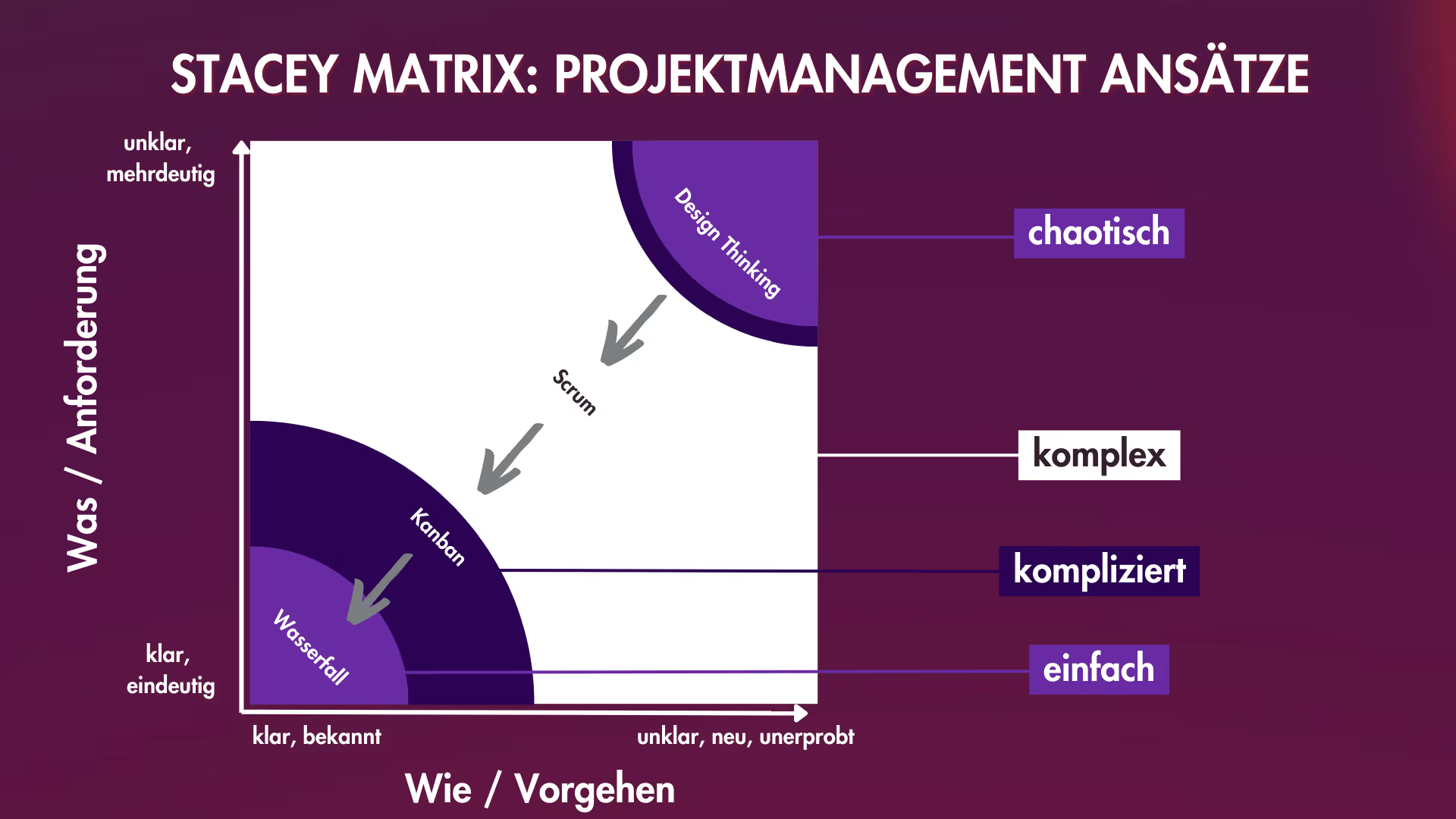
The use of the Stacey Matrix as an evaluation model plays a decisive role in choosing the right agile method. This tool helps to understand the complexity of projects and the associated uncertainty in terms of requirements and methods. By determining the positioning of the project within the matrix, it is possible to see whether traditional methods are sufficient or whether agile approaches are appropriate. Agile methods are particularly effective in complex and chaotic environments, where requirements and solutions are unclear, as they promote flexibility, rapid adjustments and iterative learning. The Stacey Matrix thus helps decision makers choose a suitable agile approach that optimally supports the company's specific needs, corporate culture and working methods and thus makes agile transformation successful.
The matrix is defined by two axes:
1. Uncertainty (or ambiguity) of requirements:
This axis moves from “clear” to “unclear.” It measures how well the requirements and goals of a project are understood at the start.
2. Uncertainty of methods:
This axis moves from “known” to “unknown.” It measures how well the methods or solutions for achieving the goals are known.
The matrix divides space into four quadrants, which represent different states of projects:
- Simple or clear: In this quadrant, both the requirements and the methods are well understood. Traditional management and planning approaches such as waterfall and V-model work best here.
- Complicated: Requirements may not be completely clear, but through expert knowledge and analysis, the methods for achieving goals can be determined. This requires detailed planning and specialized knowledge. A suitable method would therefore be to work with the Kanban model.
- Complex: The requirements are unclear, and there are no obvious methods to achieve the goals. In this area, agile methods such as Scrum or adaptive planning processes are the most effective, as they enable iterative learning and adaptation.
- Chaotic: Both the requirements and the methods are unclear. In this extreme state of affairs, rapid experiments and decisions are needed to create stability and figure out what steps should be taken next. With the help of a design thinking approach, simple prototypes can be built and tested quickly. As soon as the project is a little more mature, you can continue working with a Minimum Viable Product and the Lean Startup method.
The Stacey Matrix helps organizations recognize that no single management approach is suitable for all situations. Instead, they should assess the context of the project or problem and adjust the management style accordingly. In particular, it shows that agile methods are particularly suitable when projects have a high degree of uncertainty in terms of requirements, methods, or both.
An example from practice - Agile transformation at Barclay
The agile transformation of the major bank Barclay with around 80,000 employees has shown both challenges and impressive successes. Within the first year, over 800 teams were able to work agilely, resulting in increased turnaround time, reduced code complexity, fewer production incidents, shorter deployment cycles, and increased team satisfaction.
Barclay's challenges:
Opting for Agile: Barclays was faced with the challenge of overcoming the traditional waterfall approach and establishing a more agile, customer-oriented way of working. The need to connect agile “islands of excellence” and create a holistic transformation was decisive.
Selecting the framework: Given the size and complexity of Barclays, choosing the right agile framework was no easy task. Management needed to find a system that offered flexibility and took into account the diversity of the organization.
Adjustment of goals and measurements: The transition to Agile required a reassessment of how results are measured and financed. Traditional measurement methods were no longer suitable.
Barclay's solutions:
Holistic agile transformation: Barclays opted for a comprehensive transformation that went beyond technology departments and included everyone involved in the value stream. This approach was aimed at maximizing customer satisfaction and ultimately increasing shareholder value.
Choosing Disciplined Agile: After evaluating various frameworks, Barclays chose Disciplined Agile because of its flexibility, goal-oriented approach, and suitability for a large, heterogeneous organization. Disciplined Agile made it possible to adapt practices depending on the context and supported diversity within the organization.
Redesigning objectives and performance measurement: Barclays adapted its funding and measurement methods to promote iterative delivery and the achievement of tangible results. This included separating management goals from team measurements and introducing agility levels to help teams develop.
This transformation shows how Barclays dealt with the challenges of extensive agile implementation and implemented solutions that not only improved operational efficiency, but also laid the foundation for lasting cultural change. The results speak for themselves: improved performance, happier teams and a stronger market position through rapid adaptation to customer feedback.
Agile transformation is a complex yet rewarding journey. It requires not only the adjustment of processes and structures, but also a rethink on the part of each individual. However, with the right approach and an open attitude towards change, the above challenges can be overcome, making your organization more agile, responsive, and ultimately more successful.
Get our free Leader's Transformation Guide:
After we have examined the various challenges and solutions on the path to agile transformation, we would like to provide you with an essential resource.
Our Transformation Leader's Roadmap - The Guide to Agile and Constant Change!
This guide serves as a practical guide to guide you through the various phases of change and helps you to strengthen agility and resilience within your team. It provides concrete steps and considerations that are critical to successfully implement the right agile methods and helps you achieve your organizational goals and establish a culture of continuous improvement.